
dis·karat.
dis·karat unfolds in dialogue with one of the central questions:
what happens to the residue?
What becomes of that which remains outside the frame, corrected or discarded under the category of error?
The piece is constructed exclusively from extended trumpet techniques: aeolian sounds without defined pitch, valve clicks, unstable harmonics, multiphonics, frullato, split tones, embouchure glissandi, and smorzati with mute. Materials that, within the protocols of commercial recording, would normally be edited out or removed appear here as primary material.
Sonic remnants do not function as effect or ornament, they constitute the structural principle of the composition. The audible mechanism of the instrument, the friction of air, the instability of the harmonic, and the distance between intention and result occupy the center of listening.
The trumpet ceases to operate solely as a melodic instrument and becomes a body, object, and resonant surface. Each sound exposes a concrete materiality: metal, valve, air column, embouchure pressure, and the physical effort involved in sound production.
Just as residue alters spatial experience in Lehner's visual work, the acoustic remnant transforms the listening regime within the sonic piece. It displaces expectations of harmony, unsettles the hierarchy between sound and noise, and questions the limits of what may constitute music. The work does not seek to purity sound but to render it perceptible in its material condition. In this displacement, the remainder ceases to be waste and asserts itself as language.
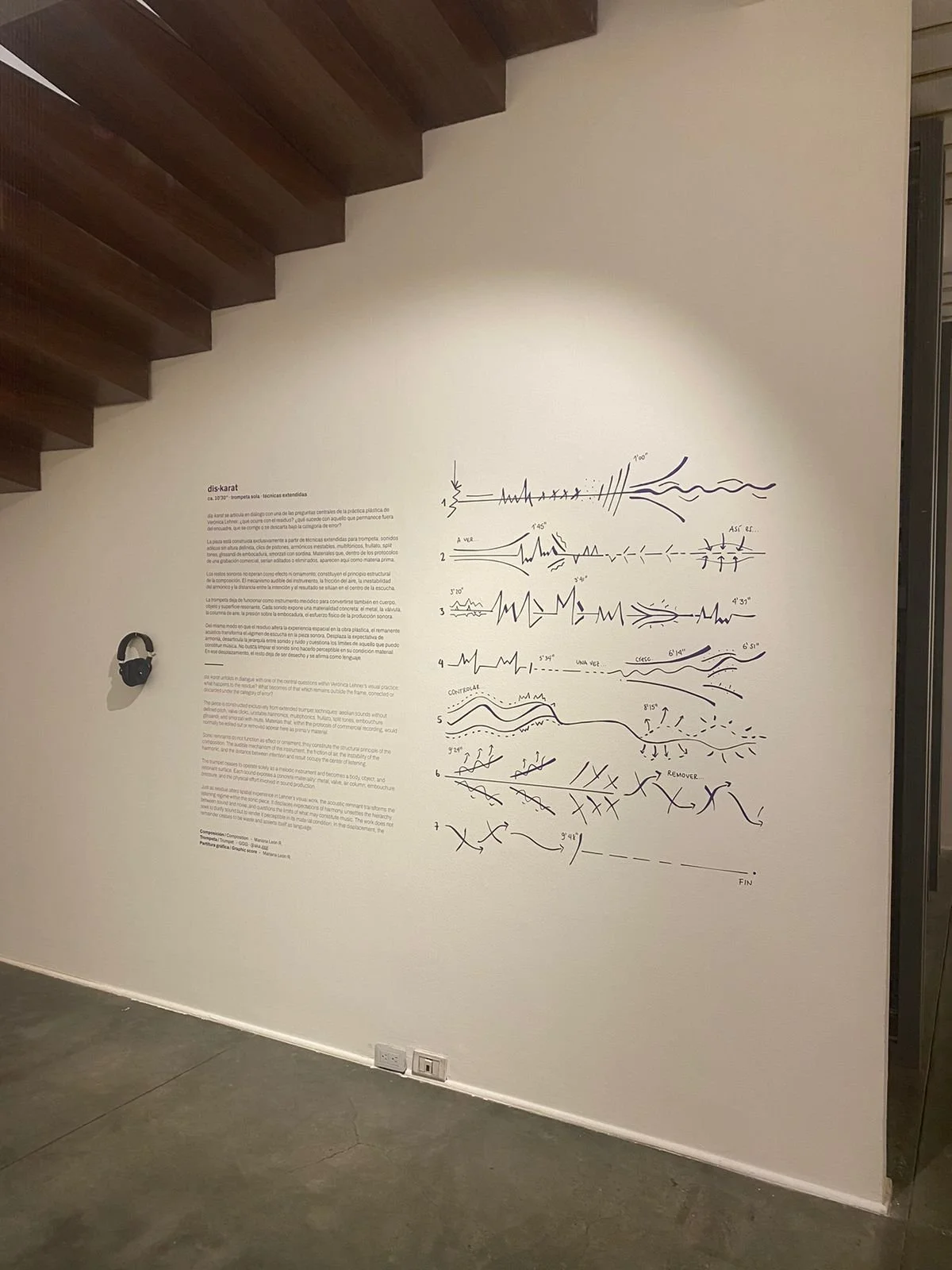
Graphic Score